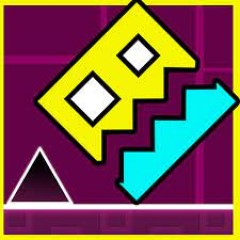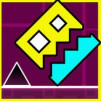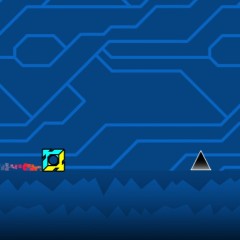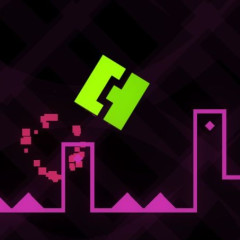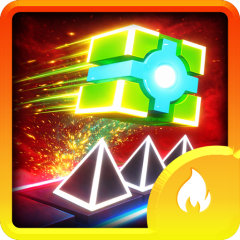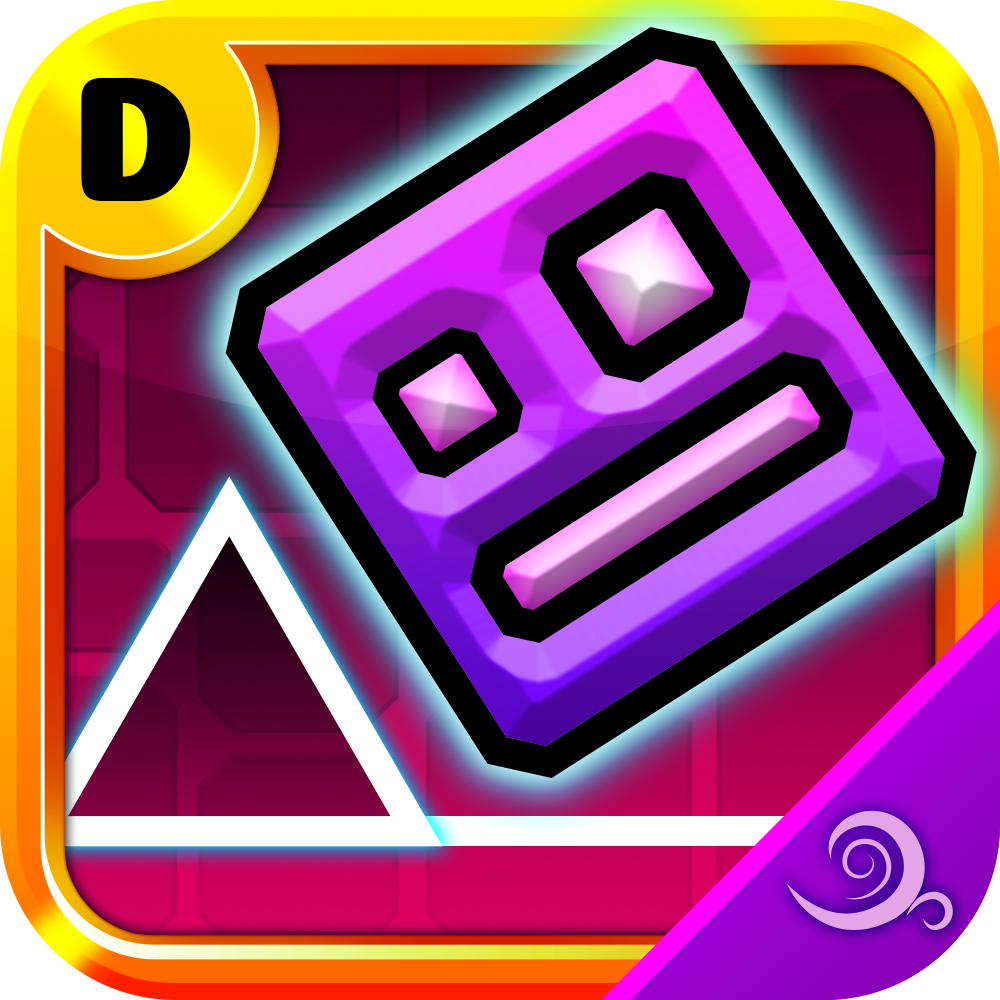
Geometry automatically travels through the level while you control the jumps. Your job is to respond to the environment and help the character move through each section without crashing.
The finish line represents the successful completion of the challenge. Getting there requires more than simply moving quickly. You need to understand the level layout and develop a reliable rhythm for each sequence.
The further you progress, the more important your timing becomes. A jump that looks easy at first can become difficult when another obstacle immediately follows it. Learning to anticipate what comes next is therefore an important part of the experience.
Geometry is destroyed when it hits an obstacle. A collision immediately ends the current attempt, making obstacle avoidance one of the central mechanics of the game.
This creates a constant balance between speed and precision. Moving too cautiously can make certain sequences harder to time, while jumping without considering the next obstacle can result in an unexpected collision.
Instead of focusing only on the current obstacle, try to look slightly ahead. Knowing what is coming next allows you to prepare your next jump before the current movement is finished.
One of the interesting aspects of I Just Might Dash is that its controls are extremely simple. There are no large combinations of keys to memorize. The difficulty comes from deciding exactly when to use the available controls.
That makes every successful section feel connected to your own timing and understanding of the level. As you repeat difficult parts, you can gradually learn the correct rhythm and turn an unpredictable sequence into a familiar pattern.
I Just Might Dash includes Practice and Normal modes, creating two different approaches to completing the level. Practice mode focuses on learning and experimentation, while Normal mode places greater emphasis on completing the entire journey in one continuous run.
Practice mode allows you to use checkpoints to restart from a section where you previously failed. This is particularly helpful when the level contains a difficult combination of obstacles.
Suppose Geometry reaches a complicated sequence and crashes several times. Instead of replaying every earlier section, you can place a checkpoint before the difficult area. Your next attempts can then focus directly on that part of the level.
This approach helps you identify exactly what makes a section difficult. You may discover that the first jump needs to happen slightly earlier, or that the following obstacle requires a quick second jump. Repeated attempts turn those observations into muscle memory.
Practice mode can also be used to explore the level without worrying about completing it immediately. Take your time, experiment with different jump timings, and gradually build familiarity with each section.
Normal mode provides a much stricter challenge. The level must be completed from the beginning to the end without stopping to restart from a checkpoint.
Every successful section therefore becomes part of one continuous run. A mistake near the end can send Geometry back to the beginning, requiring you to repeat everything again.
This mode tests whether the skills developed during Practice mode can be applied consistently. Knowing how to complete an individual obstacle is one thing; completing the entire sequence without making a mistake is another challenge entirely.
Normal mode also makes consistency important. A player may know the correct timing for every obstacle but still need several attempts before successfully putting all of those movements together.
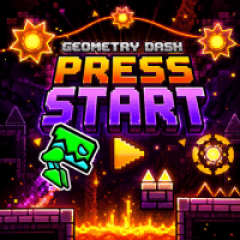
The appeal of games like I Just Might Dash comes from combining straightforward controls with demanding obstacle patterns. Once you become comfortable with precise jumping and timing, another interesting title to explore is Geometry Dash Switch, which brings its own style of fast platforming challenges and obstacle-based gameplay.