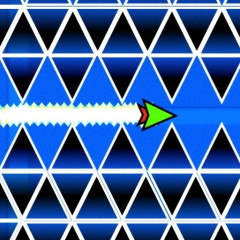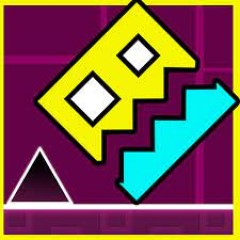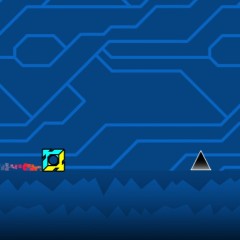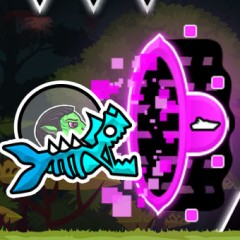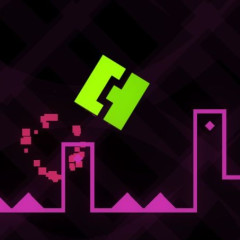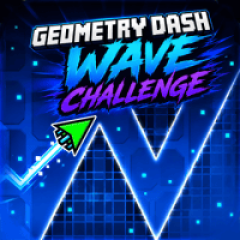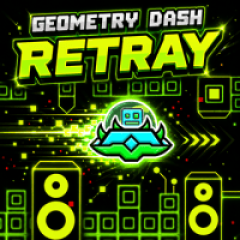
The main goal in Geometry Dash Retray is straightforward: reach the finish line without crashing into dangerous obstacles.
Your character moves automatically through the level, leaving you responsible for controlling jumps, flights, and gravity changes. There is no need to search for a separate path or explore a large map. The challenge comes from surviving the continuous sequence of obstacles.
Spikes, blocks, saw blades, gaps, and other hazards can end an attempt immediately. Even an obstacle that looks simple can become difficult when it appears during a fast section or immediately after a portal transition.
Successful players learn to recognize danger before reaching it. Instead of waiting until the last possible moment, try to anticipate your next movement based on what you have already seen.
This is why repeated attempts are valuable. Every failed run gives you more information about the level.
Memory is an important part of the experience. After several attempts, you will begin to remember where jumps, portals, speed changes, and difficult obstacles appear.
Once the layout becomes familiar, your movements can become more natural. You no longer need to react to every obstacle from scratch because you already know what is coming next.
This gradual process is one of the most satisfying aspects of the game. A section that once seemed unpredictable can become much easier after you have learned its pattern.
Speed portals can make your character move significantly faster or slower. A change in speed can affect the timing of everything that follows.
Faster sections leave less room for hesitation. You need to prepare your next action earlier and avoid relying entirely on last-second reactions.
Slower sections may appear easier, but they can still demand careful timing. Movement feels different at a reduced speed, so your usual rhythm may need to change.
Geometry Dash Retray offers two useful ways to approach the level: Normal Mode and Practice Mode. Each serves a different purpose, and understanding when to use them can make your progress much smoother.
Normal Mode is where you attempt to complete the entire level from beginning to end.
When your character crashes into an obstacle, the run ends and you need to start again from the beginning. This makes Normal Mode the true test of whether you have mastered the complete level.
It can be frustrating to fail near the end after a long attempt, but those runs are also valuable. You gain a better understanding of the level and become more familiar with its later sections.
Normal Mode is best suited to players who already know the major patterns and want to challenge themselves to complete the full stage.
Practice Mode provides a more forgiving environment for learning.
Instead of returning to the beginning after every mistake, you can continue from recent checkpoints. The mode also allows you to place your own checkpoints using the Z key and remove the latest one with the X key.
This makes it much easier to isolate difficult sections.
For example, a player might reach a complicated flying sequence and repeatedly fail there. A checkpoint placed before that section allows the player to repeat the sequence many times without spending time replaying all the easier parts.
The most effective approach is to use both modes for different purposes.
Practice Mode is ideal for learning. You can study obstacle patterns, improve reaction timing, understand gravity changes, and become comfortable with flying sections.
Normal Mode is better for testing your progress. Once you feel confident with the difficult parts, return to Normal Mode and attempt a complete run.
This combination creates a natural learning cycle: practice difficult sections, build consistency, then attempt the full level.
Players who enjoy this style of challenge may also want to explore Geometry Dash Suponho, another fan-made Geometry Dash-style level that uses familiar controls and a Practice Mode designed around checkpoints.