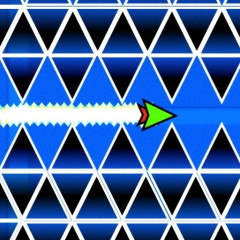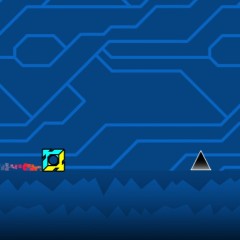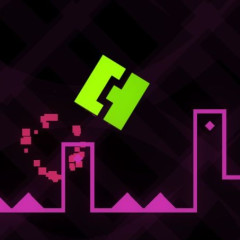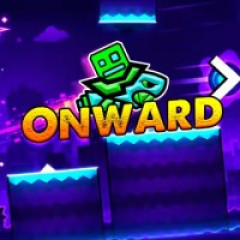
Timing is the most important skill in Geometry Dash Onward. Obstacles are positioned close together, so pressing too early or too late can quickly lead to a collision.
Try to look slightly ahead of your character instead of focusing only on its current position. This gives you more time to recognize spikes, gaps, platforms, and other hazards. With practice, you will begin to predict when each jump needs to happen.
The central objective of Geometry Dash Onward is to guide the main character safely through the entire level and reach the finish line. Because the character moves continuously, completing the course requires a combination of timing, observation, memory, and patience.
Reaching the end is not simply about moving quickly. You need to understand the layout and make accurate decisions throughout the entire run.
Obstacles are the biggest threat in Geometry Dash Onward. Spikes are among the most recognizable hazards, but they are not the only things you need to watch for. Platforms, gaps, walls, narrow spaces, and changing terrain can all create difficult sections.
Before jumping, check where your character will land. A jump that successfully clears one obstacle may still fail if the landing position puts you directly in front of another hazard.
Spikes require precise timing. Jumping too early can cause you to land before the danger has passed, while jumping too late can result in a direct collision.
When you encounter a series of spikes, avoid treating each one as an isolated obstacle. Look at the entire sequence and determine whether you need one long jump, several short jumps, or a carefully timed movement pattern.
Gaps can be just as dangerous as spikes. Your character needs enough distance and height to reach the next platform.
Pay attention to the size of each gap. A small opening may require only a quick tap, while a wider gap may need a longer or better-positioned jump. Learning the distance your character can travel will make these sections easier to handle.
Memorizing difficult sections can dramatically improve your performance. After several attempts, you will start remembering where obstacles appear and when you need to jump.
This knowledge turns reaction into preparation. Instead of seeing an obstacle for the first time, you already know what is coming and can prepare your next action.
Practice Mode is one of the most useful tools for learning difficult sections. Rather than repeatedly attempting the entire level from the beginning, you can use checkpoints to study challenging areas and improve your timing.
This is especially helpful when a particular sequence keeps causing failures. Repeat the section until the required movement becomes familiar.
Checkpoints allow you to restart from a specific position while practicing. When you reach a difficult area, place a checkpoint before it and concentrate on solving that section.
The goal is not simply to reach the end of Practice Mode. You want to understand why you failed and find a reliable movement pattern.
Repetition is an important part of Geometry Dash Onward. A section that seems impossible during your first few attempts can become much easier after repeated practice.
Try to make each attempt purposeful. Identify whether your problem is jumping too early, jumping too late, landing incorrectly, or reacting to the wrong visual cue. Then change one part of your approach during the next attempt.
Geometry Dash Onward combines familiar platforming mechanics with fast movement and challenging obstacle patterns. Its simple controls make the game easy to start, while its demanding levels give experienced players plenty of opportunities to improve.
The character keeps moving forward, creating constant pressure. You cannot simply stop and study an obstacle for several seconds. Instead, you need to observe the environment while continuing through the level.
This fast pace gives each successful section a satisfying sense of progress. The longer you survive, the harder it becomes to stay focused.
One of the most accessible features is the control system. The main action revolves around jumping, so players can grasp the basic mechanic almost immediately.
However, simple controls do not mean simple gameplay. Since the character moves automatically, the timing of each input becomes extremely important.
The level contains different types of hazards designed to test your reflexes and timing. Obstacles can appear individually or as combinations that require several carefully timed movements.
As you progress, the challenge comes not only from individual obstacles but also from how quickly they appear one after another.
Music and movement work together to create a recognizable Geometry Dash-style experience. The soundtrack can help establish a rhythm for your actions, particularly in sections where obstacles follow a predictable pattern.
Experienced players may eventually use the music as an additional timing cue rather than relying entirely on visual information.
Failure is an important part of the game. A failed run does not necessarily mean that you lack the required skill. It can reveal information about an obstacle or movement pattern that you can use during the next attempt.
This trial-and-error structure encourages players to keep improving. Every restart provides another opportunity to adjust your timing.
Players who enjoy exploring different interpretations of the formula can also try Geometry Dash Hairless Adventure, another fan-made version that offers its own level design and gameplay challenges. Switching between different fan-made games can help keep the experience fresh while allowing you to practice familiar timing and reaction skills.